


Small Tattoo Removal Sessions: What Affects the Number
Updated: 2 days ago
A small tattoo can fade well before it is fully gone. If you’re estimating how many sessions it takes to remove a small tattoo, a simple design under 2 inches may need 6-10 laser sessions for complete removal; noticeable fading can happen sooner. The number depends on more than size, including the ink and how deeply it sits in the skin.
Looking for laser tattoo removal in Hornchurch? See our Tattoo Removal treatment page for prices and booking.
It’s natural to want a clear timeline before starting treatment. This guide explains what affects how many sessions to remove a small tattoo, how black ink may respond and why treatments need time between them. You’ll also learn what recovery can involve, so you can approach tattoo removal with realistic expectations and know what to discuss at a consultation.
Table of Contents
How Many Sessions Does It Take To Remove A Tattoo?
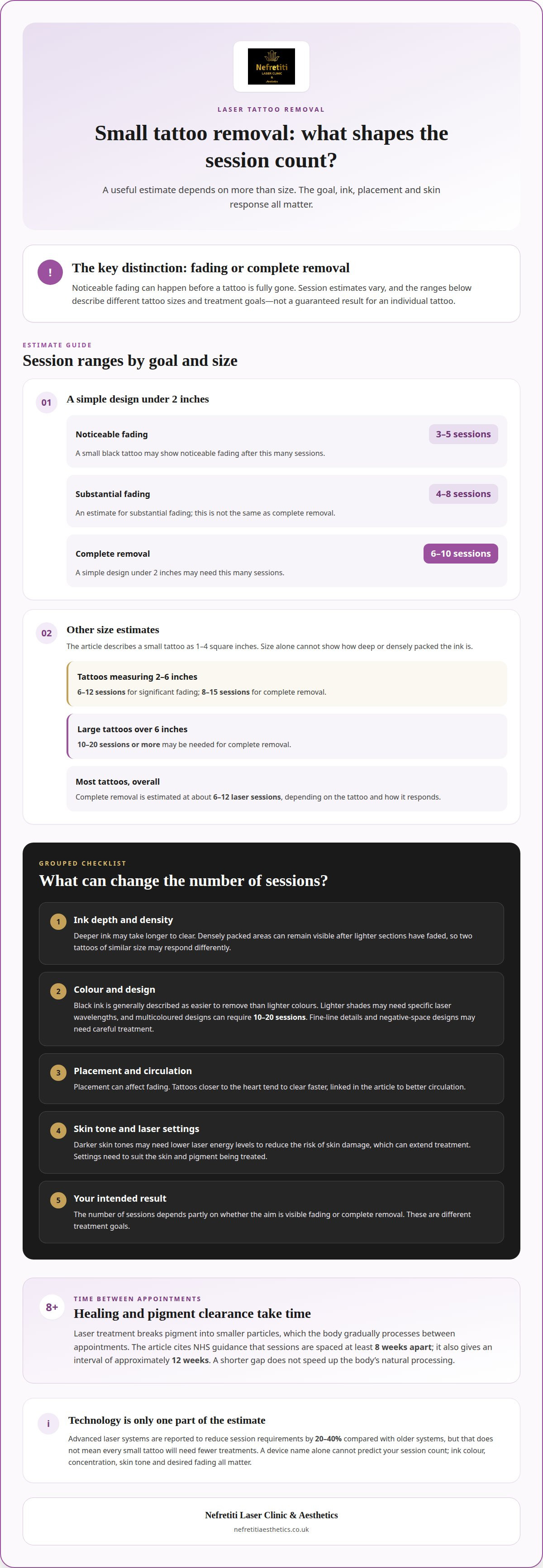
Most tattoos need about 6-12 laser sessions for complete removal, while a small, simple design may need 6-10. The number of sessions depends on how the ink, skin and tattoo characteristics respond to treatment.
Factors affecting session numbers
The number of sessions depends on how much ink needs treating and how readily your body clears it. Tattoo size alone cannot predict the full course.
Consider a small, dense design compared with a larger, lightly inked outline: the smaller tattoo may still need more work in concentrated areas. Ink colour, depth, placement, design and skin tone also influence fading. Fine-line details or negative-space designs can require careful treatment, which may affect the number of sessions. A simple black symbol under 2 inches may need 6-10 sessions for complete removal, while a different tattoo of similar size may respond differently.
Tattoo depth and ink density
Depth describes how far tattoo pigment sits within the skin, while density describes how much ink is concentrated in an area. Both affect how much pigment each treatment can break down.
A densely packed section can remain visible after lighter parts have faded, making the result look uneven between appointments. Deeper ink may take longer to clear than pigment nearer the surface. For example, two small initials may respond differently if one was applied lightly and the other with thick, layered strokes. Skin response matters too: darker skin tones may need lower laser energy levels to reduce the risk of skin damage, which can extend treatment.
Size, location and ink colour
Size determines the area treated, while location and colour influence how readily the tattoo fades. A small tattoo is described as 1-4 square inches, but size doesn’t reveal its ink depth or density.
For context, tattoos measuring 2-6 inches are commonly estimated to need 6-12 sessions for significant fading, and 8-15 for complete removal. Large tattoos over 6 inches may need 10-20 sessions or more for complete removal. These ranges describe different sizes and treatment goals, not a promise for an individual tattoo.
Black ink is generally described as one of the easier colours to remove. Lighter colours may need specific laser wavelengths, and multicoloured designs can require 10-20 sessions. Placement can affect fading too: tattoos closer to the heart tend to clear faster, linked to better circulation. Picosure is a laser name you may encounter, but the device name alone cannot determine your likely number of sessions. A consultation considers the complete tattoo, including colour, placement and skin tone.
Number of laser sessions for a small black tattoo
A small black tattoo can show noticeable fading after 3-5 laser sessions. Estimates for complete removal range from 6-10 sessions for a simple design under 2 inches, reflecting a different goal from fading.
Typical laser session requirements
Session estimates describe either visible fading or an attempt at complete removal, so the intended outcome matters. A small tattoo may become noticeably faded after 3-5 treatments, while a simple design under 2 inches is estimated to need 4-8 sessions for substantial fading. Complete removal typically takes 6-10 sessions for that size and design. These ranges help you compare expectations without treating fading and removal as the same result.
Black ink is generally considered easier to remove than lighter colours, but ink depth and density still affect the treatment course. A compact black outline and a densely filled black shape can respond differently, even when both are small. Laser tattoo removal breaks up the pigment, which the body then processes.
How the body clears broken pigment
Laser treatment breaks tattoo pigment into smaller particles, which the body gradually processes through its immune system. This continues between appointments, rather than ending when the laser session finishes.
Spacing allows time for healing and pigment clearance. The NHS says laser tattoo removal sessions are spaced at least 8 weeks apart; it also gives an interval of approximately 12 weeks apart. A shorter gap does not speed up the body’s natural processing. Follow the planned interval and allow the treated skin to recover before another session.
Laser technology and treatment needs
Laser technology affects how energy reaches different tattoo pigments, but a device name alone cannot predict the number of sessions. Advanced laser systems are reported to reduce session requirements by 20-40% compared with older systems. That comparison does not mean every small tattoo needs fewer treatments.
Colour, ink concentration and your desired degree of fading also matter. Black pigment usually responds more readily than lighter shades, which can require specific wavelengths. Laser settings must also suit the skin being treated. An approach matched to skin tone and pigment is more relevant than assuming one technology will speed up every removal course.
What alternatives are there to laser removal for a small tattoo? You can leave the tattoo as it is or cover it with clothing. A cover-up changes the visible design rather than removing the existing ink.
Are there UK rules or qualifications for providers offering laser tattoo removal? Requirements can depend on the treatment and location. Ask the relevant local authority about premises requirements, and ask the practitioner about laser-specific training and their approach to assessment and aftercare.
If you’re considering treatment, a tattoo removal consultation can help you discuss your design, skin tone and intended result.
Consultation and personalised treatment plans
A consultation turns a broad estimate into a plan based on your tattoo, skin and intended outcome. The assessment considers the design, ink colours, location, skin tone, previous treatments and whether you want fading or complete removal.
Bring details about the tattoo’s history, such as when it was applied and whether it has been treated before. A photograph can help track changes between appointments, especially when parts of a design fade at different rates. If your goal is a cover-up, explain this early: substantial fading may be the aim, rather than removing every visible trace.
The plan also needs to account for your skin’s response. Darker skin tones may require lower laser energy levels to reduce the risk of skin damage, which can extend the course. Placement matters too: body areas can differ in sensitivity, affecting treatment tolerance and the spacing between visits. These details help shape an approach around your tattoo rather than relying on an average estimate.
Laser treatment breaks pigment into particles that the body processes over time. The skin needs a chance to recover between sessions, and closely repeating treatment cannot make that natural process happen instantly. Longer intervals give the body more time to process ink and may allow further fading before the next appointment.
For context, a course of six sessions is estimated to take at least 8-10 months, allowing for healing between treatments. Complete removal can take from five months to over a year, depending on the tattoo and treatment course. These timelines show why the calendar can extend well beyond the time spent in each appointment.
Changes can become apparent at different stages. Some tattoos may fade significantly after one or two sessions, while others show clearer fading after two to three. Compare photographs taken in similar lighting rather than judging the tattoo immediately after treatment. The final result may not be visible until a year or two after treatment begins, as fading continues over time.
Discuss sun exposure between treatments at your review. Tell the practitioner if the treated area has recently been in strong sunlight or its appearance has changed. This context can help when assessing the skin and planning the next laser treatment. Don’t rely on a photograph alone if the skin looks different in person.
Use each review to discuss fading, healing and any changes since the previous appointment. Keeping a record of treatment dates, photographs and skin response can make progress easier to assess. If healing takes longer than expected, mention this before proceeding, so the next step reflects the skin’s condition rather than a fixed calendar.
Tattoo removal recovery and healing
Healing is part of tattoo removal, not a pause in progress. The treated skin needs time to recover while the immune system processes ink particles.
Skin type and healing
Skin type affects how laser energy is selected and how the treated area responds. Treatment settings and healing needs should account for your skin, not just the tattoo.
Darker skin tones may require lower laser energy levels to reduce the risk of skin damage, which can extend treatment. Skin tone and ink colour are different factors: a black tattoo on darker skin still needs an approach suited to both skin and pigment. Tell the practitioner about any changes in your skin and previous reactions before another session.
Aftercare during recovery
Aftercare means following the instructions given for the treated area while it heals. Another laser session is not a substitute for recovery between appointments.
Follow the aftercare advice provided for your treatment, and avoid picking or scratching the area. If the skin looks different from the expected response, or healing concerns you, contact the practitioner before your next appointment. Mention sun exposure at your review, especially if the treated skin’s appearance has changed. Yellow ink may fade differently from black pigment, but the skin still needs time to recover.
Recovery risks and side effects
Risks and side effects are unwanted changes or reactions in the treated skin. Discussing them matters because the laser targets tattoo pigment, while the surrounding skin also needs consideration.
Possible concerns include changes in skin appearance or healing that takes longer than expected. Skin tone, the laser approach and how the area responds are all relevant. Ask what reactions to expect and which changes warrant professional review. Report unexpected symptoms rather than assuming they are part of normal recovery.
How long should you wait between laser tattoo removal sessions? The NHS says sessions are spaced at least 8 weeks apart and are approximately 12 weeks apart. The treated skin needs time to heal between appointments.
Treatment intervals help explain why removal takes time beyond the appointment itself. Laser treatment breaks pigment into smaller particles, which the immune system processes gradually. The tattoo can continue fading between visits, so an early review may not show the final change.
Healing can also affect when treatment resumes. Proceeding simply to keep a calendar date, when the treated area has not recovered, can overlook the skin’s condition. Share any healing concerns before the next session, and follow the aftercare guidance provided for your treatment.
Recovery can vary across the treated area, particularly when a tattoo has different colours or densely inked sections. For example, a black outline and a yellow detail may fade at different rates. Track changes between sessions and discuss them at review. This helps distinguish ongoing fading from a skin concern that needs attention.
Sessions needed for complete tattoo removal
Complete removal usually takes more sessions than visible fading. Most tattoos need about 6-12 laser sessions for complete removal, while a simple tattoo under 2 inches is estimated to need 6-10. These figures describe different tattoo types, not a fixed course for every small design. A useful takeaway is to separate the goal of substantial fading from the goal of eliminating visible ink.
Size categories also affect estimates. Small tattoos are described as measuring 1-4 square inches, while one estimate places tattoos under 4 square inches at 10-12 sessions. A simple design under 2 inches has a separate estimate of 6-10 sessions. These figures don’t align perfectly because size alone leaves out ink density, colour, depth and design complexity. A small, densely filled shape may require more treatment than a lighter outline.
Fading is a different endpoint. A small tattoo may be noticeably faded after 3-5 sessions, and a simple dark design may fade substantially after 4-6. For a cover-up, the aim is often to lighten the original tattoo enough for another design, rather than remove every trace. Estimates for cover-up fading range from 3-8 sessions. Agreeing on the intended result helps make a session estimate meaningful.
Laser pulses break tattoo ink into smaller particles, which the body processes over time. That means the visible change continues between appointments, rather than appearing all at once during treatment. A black outline may fade differently from coloured sections, and a multicoloured tattoo can require 10-20 sessions. Complete removal is therefore influenced by the slow clearance of pigment as well as the laser treatment itself.
Use estimates as planning guides, not as a promise of a specific finish. For example, a small black symbol with simple lines fits the 6-10-session estimate more closely than a compact design with dense, layered colour. Larger tattoos over 6 inches may need 10-20 sessions or more for complete removal. The ranges reflect different sizes and tattoo characteristics, so comparing your design with another person’s session count can be misleading.
Time also matters. A course involving 15-20 sessions can take 2-3 years, because treatments need recovery intervals and fading continues between visits. The final result may not be visible until a year or two after treatment begins. Allowing for that gradual process helps set realistic expectations: the number of appointments and the time until the last visible pigment fades are related, but not identical.
A consultation can establish whether your priority is complete removal or a lighter starting point for a cover-up. Discuss your tattoo’s size, colours and design, then use the treatment plan to track progress between sessions.
Nefretiti Laser Clinic & Aesthetics: Laser Hair removal
Nefretiti Laser Clinic & Aesthetics offers laser tattoo removal for people considering fading or removing unwanted ink. A consultation lets you discuss the tattoo’s colour, size, placement and your preferred outcome, then understand how these factors shape a treatment plan.
Knowing that complete removal can take multiple appointments, with time needed between sessions, can help you plan for healing and gradual fading. The team can discuss the process and aftercare, and assess whether treatment is suitable for your skin and tattoo. Laser hair removal is also available, but it treats unwanted hair rather than tattoo ink.
Based in Elm Park, Hornchurch, the clinic welcomes clients from nearby areas including Romford and Upminster. For a calm, personalised discussion about tattoo removal, contact Nefretiti Laser Clinic & Aesthetics or visit nefretitiaesthetics.co.uk.
Choose the next step that feels right for you
It’s easier to decide whether to begin when you define the result you want. Asking how many sessions to remove a small tattoo is useful, but your preferred endpoint matters too: softer visibility, a clearer canvas for a cover-up, or the fullest fading possible.
Before deciding, consider what matters most: keeping the design partly visible, reducing its contrast or pursuing removal. Bring these priorities to a consultation, along with any concerns about comfort, recovery or how the area may look between appointments. You can also discuss how you’d feel if some ink remained, so the goal reflects your preferences rather than an assumed definition of success. A clear goal gives the conversation a practical focus.
A considered discussion can help you decide whether to proceed, pause or take more time. Results vary, and a practitioner can explain the options after an assessment. You deserve space to make the choice that feels right for you.
Frequently Asked Questions
How Many Sessions Are Needed?
There isn’t one session count that applies to every tattoo. The estimate depends partly on whether you want the ink fully removed or faded enough for a cover-up. Ask for an estimate based on your chosen outcome, rather than a general average. You can then decide whether the likely course fits your expectations and discuss how progress will be reviewed as treatment continues.
What is Considered a Small Tattoo?
“Small” describes a compact tattoo, but the label alone doesn’t determine its treatment needs. A practitioner can assess the design’s actual dimensions and ink coverage instead of relying on how small it looks at a glance. To prepare for an assessment, take a clear photograph and note the tattoo’s approximate length and width. This gives you a more useful starting point for discussing its size.
How many laser sessions does it take to remove a small tattoo?
A simple tattoo under 2 inches is estimated to need 6-10 sessions for complete removal. That estimate is a starting point, not a promise of the final result. Before beginning, ask how progress will be assessed and whether the plan aims for complete removal or reduced visibility. This helps you understand what the estimate means for your own goal and how decisions about further treatment will be made.
What factors affect the number of tattoo removal sessions?
The estimate depends on the tattoo’s characteristics and your skin’s response. For a more useful assessment, explain when the tattoo was applied, whether it has been treated before and what result you want. Bring clear photographs if you have them, especially if the tattoo has changed over time. This information helps the practitioner discuss your case rather than rely only on a general estimate.
Is a Q-switched Nd:YAG laser suitable for every small tattoo?
No single laser type is suitable for every tattoo. A Q-switched Nd:YAG laser with a 1064 nm wavelength is described as safe for tattoo removal on darker skin types, but that fact doesn’t establish that it suits every ink colour or skin. The treatment approach should take both the tattoo and the skin into account. A laser name alone cannot predict the result or session count.
Can a small tattoo be removed completely, and how likely is fading or residual ink?
Complete removal can be the aim, but some ink may remain after treatment. There isn’t a reliable percentage that applies to every small tattoo, so giving a precise likelihood would be misleading. Consider what outcome would feel acceptable if faint traces persisted. Discuss this before starting, especially if you’re choosing between pursuing further fading and stopping once the tattoo is less noticeable.
How should you prepare for and care for skin after a tattoo removal session?
Before your appointment, share relevant treatment history and follow the preparation instructions provided for your session. After treatment, follow the practitioner’s aftercare guidance rather than applying products or changing your routine without advice. Keep a simple record of appointment dates and take photographs in consistent lighting to compare changes. If you’re concerned about how the skin is healing, seek advice before your next session.
Which laser types are used to remove small tattoos, and how do they compare?
The article mentions Picosure and advanced laser systems, but a device name alone cannot predict the number of sessions. A Q-Switched Nd:YAG laser at 1064nm is described as safe for darker skin, while advanced systems are reported to reduce session requirements by 20-40% compared with older systems.
Comments